 Le Roch Lab
Epigenetics & Chromatin
Epigenetics & Chromatin2026
Host-cell dependent epigenetic profiles associated with survival outcomes in T. gondii infection
Ciampossin L, Ulu A, Lenz T, Li Z, Abel S, Srivastava S, White M, Wilson E, Le Roch KG
Research
The question
Combining large genomic data sets to investigate how intracellular parasites such as Toxoplasma gondii manipulate host chromatin to evade immune responses and promote parasite persistence in humans.
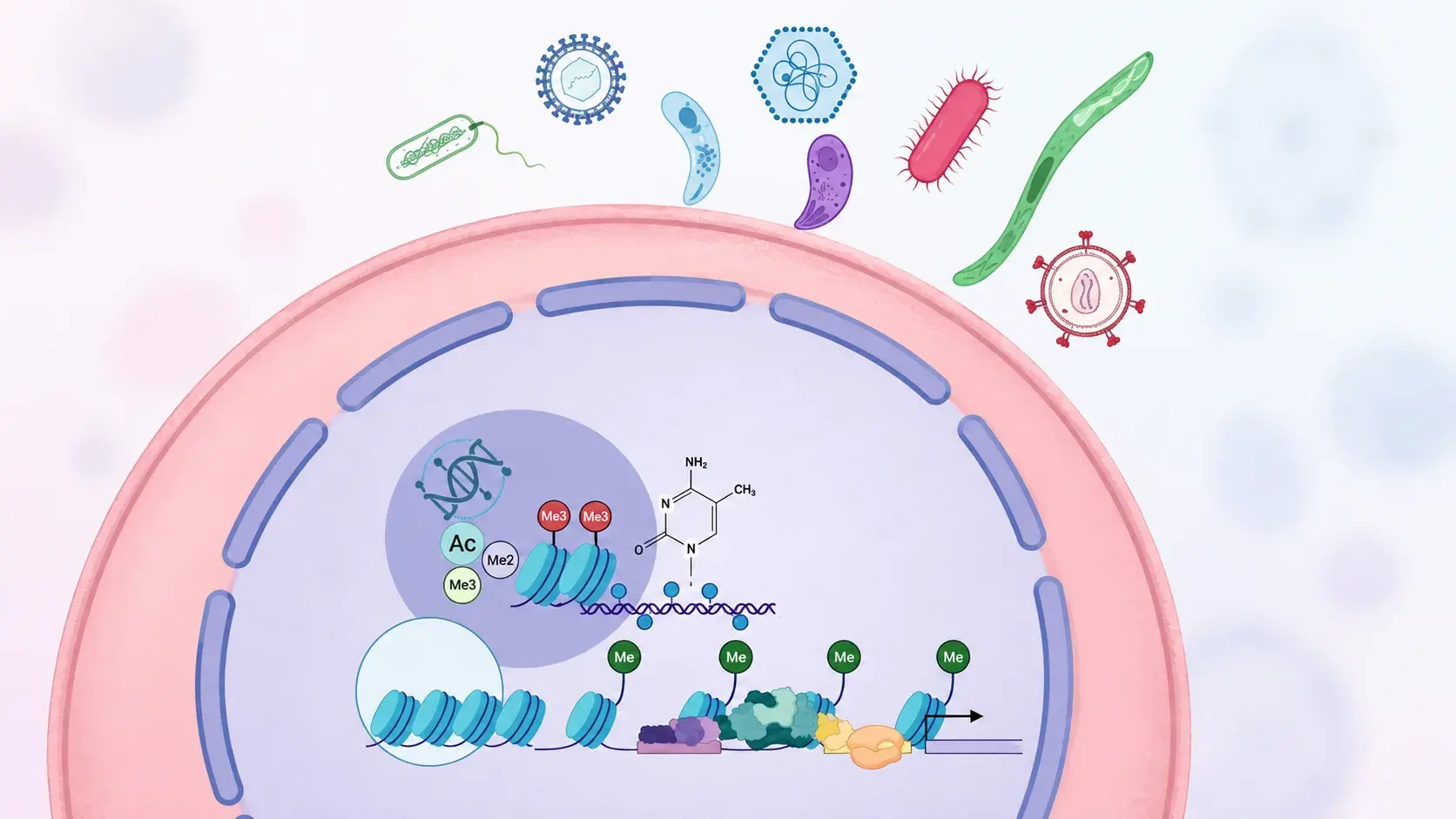
An intracellular parasite does not simply hide inside a host cell — it changes how that cell behaves. Persistence depends on reshaping host gene expression enough to blunt the immune response without killing the cell the parasite lives in.
We approach this from the chromatin side, on both genomes at once: which host genes are marked, which are made accessible, and how the parasite's own three-dimensional genome organisation supports the switch to a persistent state. Comparing that architecture across apicomplexan species separates what belongs to one parasite from what is shared strategy.
How we look
Host & parasite chromatin
Cell biology & readout
Platforms
Ciampossin L, Ulu A, Lenz T, Li Z, Abel S, Srivastava S, White M, Wilson E, Le Roch KG

Grilo Ruivo MT, Shin JH, Lenz T, Matsuno SY, Yanes KO, Graindorge A, Hamie M, Berry-Sterkers L, Gissot M, El Hajj H, Le Roch KG, Lodoen MB, Lebrun M, Penarete-Vargas DM
Bunnik EM, Venkat A, Shao J, McGovern KE, Batugedara G, Worth D, Prudhomme J, Lapp SA, Andolina C, Ross LS, Lawres L, Brady D, Sinnis P, Nosten F, Fidock DA, Wilson EH, Tewari R, Galinski MR, Ben Mamoun C, Ay F, Le Roch KG
Lai Y, Cuzick A, Lu XM, Wang J, Katiyar N, Tsuchiya T, Le Roch K, McDowell JM, Holub E, Eulgem T