 Le Roch Lab
Cell Reports2025
RAP proteins regulate apicoplast noncoding RNA processing in Plasmodium falciparum
Hollin T, Chahine Z, Abel S, Banks C, Pasaje CFA, Lenz T, Prudhomme J, Ybanez CM, Abbaszadeh AS, Niles JC, Florens L, Le Roch KG
Research
The question
Deciphering the role of long non-coding RNAs and RNA-binding proteins in gene regulation, and how they shape the transcriptome across the parasite life cycle.
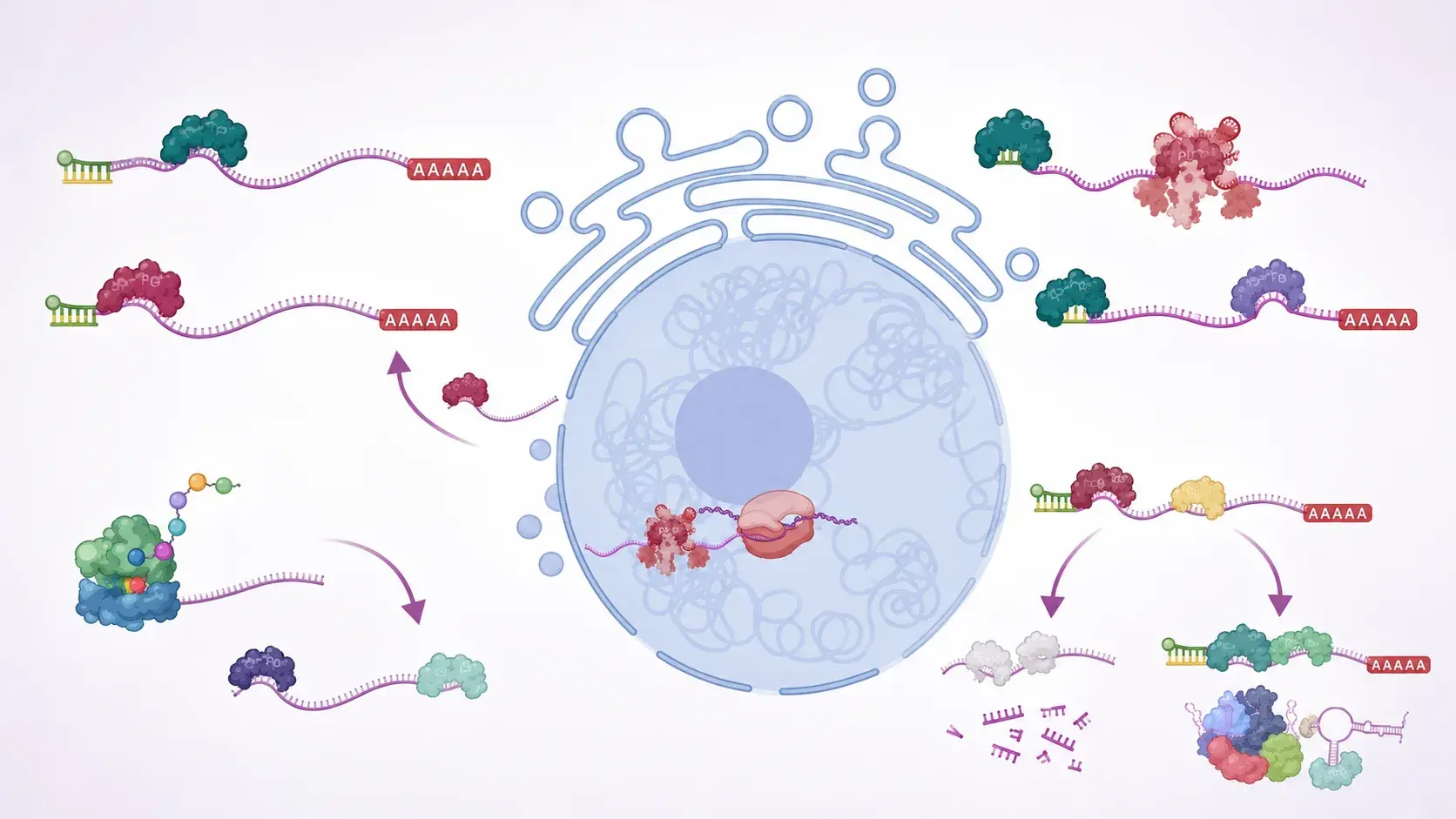
Transcription explains only part of what the parasite does. Between a gene switching on and a protein appearing, transcripts are bound, stabilised, moved and silenced — and in these parasites that layer carries an unusual share of the regulation, holding messages made at one stage in reserve until the next.
We map it from two directions. Proteome-wide screens identify which proteins bind RNA at all, including a family of RAP proteins with roles in the apicoplast and the mitoribosome; eCLIP-seq and ChIRP-seq then pin individual proteins and long non-coding RNAs to the transcripts and genomic sites they occupy. The lncRNA catalogue that came out of that work is now being tested for function rather than presence.
How we look
RNA–protein interaction
Transcriptome
Platforms
Hollin T, Chahine Z, Abel S, Banks C, Pasaje CFA, Lenz T, Prudhomme J, Ybanez CM, Abbaszadeh AS, Niles JC, Florens L, Le Roch KG
Hollin T, Abel S, Banks C, Hristov B, Prudhomme J, Hales K, Florens L, Stafford Noble W, Le Roch KG
Batugedara G, Lu XM, Hristov B, Abel S, Chahine Z, Hollin T, Williams D, Wang T, Cort A, Lenz T, Thompson TA, Prudhomme J, Tripathi AK, Xu G, Cudini J, Dogga S, Lawniczak M, Noble WS, Sinnis P, Le Roch KG
Abel SM, Hong Z, Williams D, Ireri S, Brown MQ, Su T, Hung KY, Henke JA, Barton JP, Le Roch KG
Hollin T, Abel S, Falla A, Pasaje CFA, Bhatia A, Hur M, Kirkwood JS, Saraf A, Prudhomme J, De Souza A, Florens L, Niles JC, Le Roch KG